
Bipartisan hate laws must be resisted
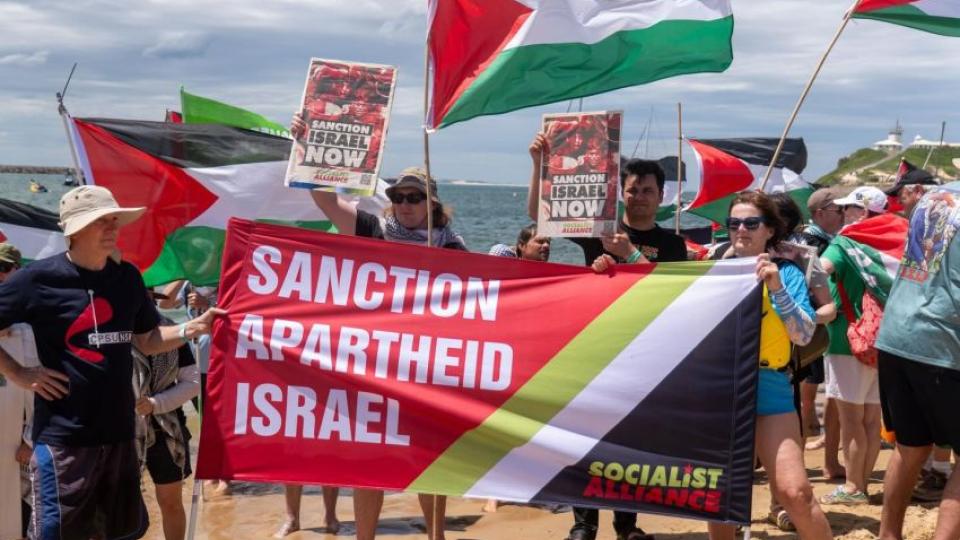
Socialist Alliance opposes Labor’s Combating Antisemitism, Hate and Extremism Bill (Criminal and Migration Laws) 2026. People who want the right to oppose genocide, or to defend democratic rights more generally, should reject these laws.
The laws, which passed with Liberals’ support on January 20, allow the minister for the Australian Federal Police to declare an organisation as a “hate crime group”, which would then criminalise membership and support for that group and the use of its symbols.
Judicial reviews of declarations will be limited because hearing first from a group before it is banned (procedural fairness) is not required.
The laws also mean the government can deny visas on as little as a suspicion that hate crimes will be carried out in the future.
The laws provide the Australian state with more means to police and imprison oppressed people, starting with those who face racism.
However, its big target is the Palestine solidarity movement. The ABC’s January 20 7.30 interview with Labor Attorney-General Michelle Rowland revealed this. Rowland was asked if a group “saying that Israel is engaged in genocide or condemning Israel, saying it shouldn't exist and Jewish Australians feel harassed or intimidated, they can be banned for that reason?”
She replied: “If those criteria are satisfied, then that is the case.”
How? First, Professor Ben Saul, the United Nations’ Special Rapporteur on the promotion and protection of human rights and fundamental freedoms while countering terrorism, warned in his parliamentary committee submission that the use of terms like “advocate” in the “objects” of the law banning hate crime groups “are vague and overbroad and prone to arbitrary application and abuse”.
“Incitement,” he wrote, “is the appropriate concept to use” — that is, to provoke — rather than more general “promotion”.
The law’s result will be “unjustified restrictions on freedom of expression and other rights”, Saul said, contrary to its claim that it enacts human rights obligations.
The laws, in turn, define a hate crime not just as violence and property damage, or the threat or risk of that.
Also included is “conduct … that involves publicly inciting hatred”, which is a federal or state offence and “would, in all the circumstances, cause a reasonable person who is the target, or a member of the target group, to be intimidated, to fear harassment or violence, or to fear for their safety.”
Yet, the New South Wales Law Reform Commission warned in 2024 that “hatred” is too imprecise and an “inappropriate standard for the criminal law” because there are significant “differences of opinion in the community about what hatred means”.
Making the “reasonable person” test in criminal law specific to the targeted group, which is ostensibly concerned for that group’s sensibilities, is a discriminatory and undemocratic departure from the general “reasonable person” test.
The only racism the new hate crime laws mention is antisemitism, but they don’t define what this is.
Meanwhile, many Australian state institutions, most political figures (including Labor, Teal, Coalition and One Nation MPs) and most establishment media treat the Jewish community as an homogeneous whole.
This is not only in relation to anti-Semitism — the hatred of Jews as Jews — but their support for Zionism, the ideology of settler-colonialism in Palestine, to falsely equate criticisms of the state of Israel, for genocide and occupation, with antisemitism.
Jillian Segal, Special Envoy to Combat Antisemitism, is a leading proponent of Zionism, is campaigning for the government and bureaucracies to adopt the International Holocaust Remembrance Alliance (IHRA) working definition of antisemitism. The IHRA definition’s examples often present criticism of the Israeli state or Zionism as antisemitism.
As well, from claims that a majority of Jews support Zionism an argument is made that Zionism is part of Jewish identity. The antisemitism definition adopted by peak university management body, Universities Australia, does this.
But, like Australians as a whole, some Jews disagree with the state of Israel and the Australian government’s support for it, while others insist that is antisemitic.
Zionists — Jewish, Christian or unreligious — support Jewish ethno-nationalism within historic Palestine and are thus a politically constituted oppressor group. They are not alone, because racists’ efforts to make out their political stances are attached to ethnic identities or nationality, and to silence dissent, including such catch-cries as “un-Australian” and “self-hating Jew”.
Constitutional lawyer Anne Twomey argued in the January 28 The Conversation that criticism of the actions or policies of another country is ordinarily “a political communication” not regarded as inciting hatred”. Rowland’s position on the Palestine solidarity movement contradicts that.
Labor and the Liberals backed that position, rejecting Independent Senator Lidia Thorpe’s amendment that referred to a Federal Court judgement which confirmed such criticism “is not inherently criticism of Jewish people and is protected political speech”.
Twomey suggests that hate crime laws could chill “freedom of political communication by those who wish to protest against the conduct of a nation’s government”.
Finally, the new hate crime laws criminalise not just formal membership of a banned group, but “informal” membership of and “support” for banned groups. These laws therefore cast their net very wide.
More than half the country believes a genocide has been committed in Gaza; if they act on that belief in a public way, criminal sanctions appear to be possible.
Like these laws, Australia’s institutions reek of a racism normalised to sustain its settler-colonial society. Within that, far-right groups (like the now self-disbanded National Socialist Network) will find ways to propagate their ideology. The so-far muted institutional response to the bomb attack on the Invasion Day rally in Boorloo/Perth testifies to this.
Labor’s rushed hate crime laws show it did not aim to build public support to address hate and violence. Instead it rushed to shut down anti-racist movements and give the police and courts more powers to crack down on First Nations and migrant communities.
However, there is resistance. After South Australia’s Premier Peter Malinauskas pushed to cancel Palestinian-Australian author Randa Abdel-Fattah from the Adelaide Writers’ Week, the revolt of most of the authors and festival staff, including the Jewish Writers’ Week director Louise Adler, forced a reversal of Abdel-Fattah’s cancellation in future years.
National preparation is well underway for protests to greet Israel’s President Isaac Herzog when he arrives on February 9-12.
Socialist Alliance supports anti-racist organising and the defence of democratic rights through powerful popular movements. Palestine solidarity is the critical popular mobilisation that needs to be defended if we are going to push back the racist (including antisemitic) far right.
[Jonathan Strauss is a member of the Socialist Alliance National Executive.]