
Students say ‘No’ to Hanson — a powerful example
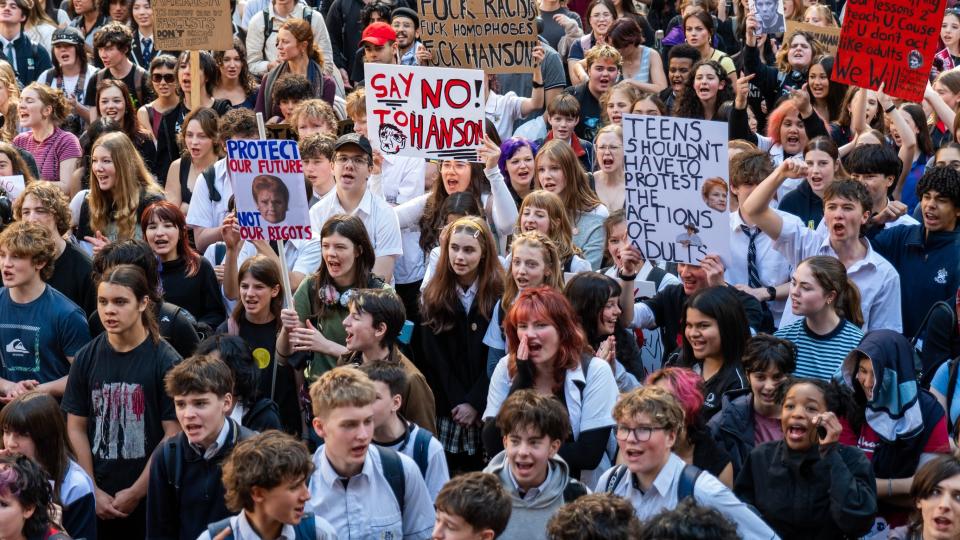
Once again, students have demonstrated moral leadership in this country.
The thousands of mainly school students — who walked out of class on August 13 as part of the “Students say No to Hanson” national day of action called by the National Union of Students — took the sort of mass action that other sections of society need to follow.
Just as in July 1998, when about 10,000 students mobilised around the country in response to the earlier political rise of Pauline Hanson and her racist One Nation party, the trade unions were too conservative, or too timid, to mobilise their members against her toxic, right-wing populist politics of hate and division.
As a direct consequence of this political failure, a significant section of the working class was duped into supporting One Nation in the late 1990s, and more so today.
Numerous opinion polls, taken over the past few months, show that an even bigger proportion of the working class is being duped into supporting One Nation, compared to the late 1990s.
While recent polls do show some decline, One Nation continues to log about 25% support. It is exploiting public disenchantment with the traditional parties of government, which has been sharpened by the cost-of-living crisis and growing global instability.
Labor and the Liberal-National Coalition have been complicit in implementing neoliberal policies, which have eroded the living standards and economic security of the majority of people and greatly enriched the billionaire class and their corporations.
Labor and the Coalition are also complicit in pursuing a pro-war and imperialist alliance with the United States, which has created unending wars, which, in turn, have generated a chronic global refugee crisis.
The major parties have also implemented racist, inhumane and illegal anti-refugee policies — setting a reactionary example for other right-wing governments, including the Donald Trump administration. In the process, these parties have fuelled racism.
This is not the first time that students have shown a powerful political lead in this country.
In the 1960s and 1970s, students took the lead in the eventually successful movement against the imperialist war on Vietnam.
Only a minority opposed the Australian government’s “all-the way-with-the-USA” approach to the Vietnam War. But students took to the streets again and again, bravely facing down sometimes violent police repression.
The thousands of students who became involved in these movements took anti-war arguments into their schools and campuses and to their families. Many won over their more conservative parents.
Back then, right-wing media and politicians accused students of being “brainwashed” and “misled”. In reality, it was those duped by conservative and right-wing ideas who were brainwashed.
The more the right accused the students of being misled, or not acting of their own volition, the more it lost the argument.
Following the August national day of action, another has been called for September 17. Such a youth-led opinion shift may, once again, play out over the coming months and could significantly shape politics for the better.
Speaking to students protesting against Hanson revealed similarities with the anti-Vietnam War movement, which I took part in. Quite a few told me that some of their family members supported One Nation, and some even said that was why they had decided to join the protest.
But there was also something new; students made it very clear that they were not only morally outraged by One Nation’s toxic politics of division, but they were protesting out of solidarity for their friends and schoolmates, being targeted by racism, misogyny, transphobia, homophobia and Hanson’s push for a “monoculture”.
Their opposition to Hanson was deeply personal and organic. “This is our future,” they said, “and Hanson and One Nation are out to wreck it”.
This deeply-felt rejection of One Nation’s reactionary politics and its destructive vision for the future shows up in a sharp generational divide in the opinion polls, which show overwhelming rejection of One Nation by “Gen Z”.
In this sense, right-wing populism has already lost the future.
If students keep taking this powerful rejection into the streets, history shows it can liberate large sections of society currently duped by One Nation’s politics of fear, hate and division. Unions and progressive sectors of society can and should back them.
[Peter Boyle is a long-term anti-racist activist and member of the Socialist Alliance National Executive. He is running for Socialist Alliance in the NSW elections in March 2027.]